


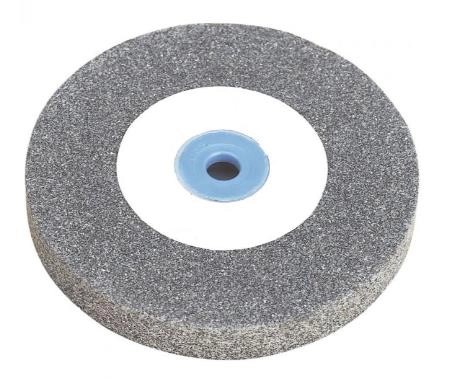
Resin bond abrasives are available in various types, including brown fused alumina (A), white fused alumina (WA), single crystal alumina (SA), micro-crystalline alumina (MA), chrome corundum (PA), zirconia corundum (ZA), and black corundum (BA). Additionally, there are abrasive series such as black silicon carbide (C), green silicon carbide (GC), cubic boron nitride (CBN), and cubic boron carbide (BC). The super-hard abrasives include synthetic diamonds (RVD, MBD, SCD, SMD, DMD, M-SD) and cubic boron nitride (CBN, M-CBN).
When manufacturing resin-bonded abrasives, the magnetic material content is not highly demanded, but strict requirements are imposed on the quality of the abrasive particle surfaces. The presence of graphite and dust on the abrasive surface reduces the bonding strength between the resin and abrasive particles, resulting in decreased hardness and stability of the abrasive tool. To enhance the bond ability between the abrasive and bonding agent, as well as to improve the strength, toughness, and wear resistance of the abrasive, additional treatments are necessary. These treatments include calcination, particle shaping, surface coating, and surface corrosion of the abrasive.
1. Calcination treatment of abrasive particles: Calcining corundum abrasives at temperatures between 800-1300°C for 2-4 hours significantly improves the micro-hardness, toughness, and hydrophilicity of the abrasive particles. However, when the temperature exceeds 1300°C, the performance of the abrasive particles declines. The effect of calcination treatment is noticeable for corundum abrasives but not for SiC abrasives.
2. Specialized manufacturing processes for abrasive particles: Using the block melting method to produce corundum abrasives results in larger crystal particles, which enhances the strength and hardness of the abrasive. The rolling method is employed for particle processing to increase the presence of flake and needle-shaped particles while ensuring a rough surface. Following the rolling process, sieving improves the uniformity of the abrasive particle size distribution and removes impurities, dust, and coarse particles.
3. Surface coating treatment of abrasives: This treatment involves applying a thin layer of material onto the abrasive surface, followed by heat treatment and loose sieving. Its purpose is to enhance hydrophilicity and increase the surface roughness of the abrasive particles. Coating methods include metal salt treatment, resin treatment, ceramic slurry-saline treatment, and alkali corrosion treatment. The choice of coating treatment for corundum abrasives depends on the specific requirements of the abrasive tool.
4. Coating treatment for super-hard abrasives: Coating the surface of super-hard abrasives with different materials creates new abrasive varieties with distinct properties. The purpose of the coating is to endow the super-hard abrasive particles with special physicochemical properties, thereby improving the performance and effectiveness of the abrasive tool and enhancing its durability. Typical coating materials include copper, nickel, molybdenum, copper-tin-titanium alloy, and non-metallic materials such as ceramics, titanium carbide, and titanium nitride.
Currently, the majority of resin-bonded diamond tools, approximately 90%, utilize diamond abrasives with metal coatings such as copper and nickel. The use of CBN-coated abrasives reduces the percentage of abrasive loss from 60% to 30%. Copper-coated abrasives are suitable for dry grinding, while tin-coated abrasives are suitable for wet grinding. The advantages of coated super-hard abrasive particles are as follows:
A. Improved abrasive particle strength by 30%-60%: RVD diamonds and CBN, being brittle materials, experience improved toughness when coated with a thin layer of copper or nickel, allowing them to withstand greater external impact forces. During the coating process, the plating solution penetrates the surface cracks, pores, and voids of the abrasive particles, repairing defects and strengthening the RVD diamonds and CBN particles.
B. Enhanced wettability of resin bond to super-hard materials: Coating treatment improves the resin’s bonding ability to the abrasive particles, thereby increasing the durability of the abrasive tool. Experiments have shown that when using uncoated super-hard tools to dry grind hard alloys, approximately 70% of the abrasive particles are underutilized and directly detach. However, when using coated RVD diamonds and CBN tools, the detachment of abrasive particles is significantly reduced.
C. Thermal barrier effect of the metal coating: The metal coating on RVD diamonds and CBN serves as an effective thermal barrier during the grinding process. The generated heat from grinding is transferred to the metal film and then passed on to the bonding agent. As a result, the accumulation of grinding heat is reduced, minimizing the probability of resin decomposition due to reaching the carbide formation temperature. This ensures the bonding strength between the resin and abrasive particles, allowing the abrasive particles to fully exert their grinding capabilities.
D. Reduction in self-sharpening of coated RVD diamonds and CBN: The metal coating on the abrasive particles reduces their self-sharpening ability, resulting in a 10%-20% increase in grinding power consumption during the grinding process.
E. Adjusting the resin bond formulation and selecting the appropriate abrasive concentration: Resin-bonded super-hard tools require finer abrasive particle sizes, with recommended grit sizes below 100μm/120μm, ranging from fine to micro powders. The resin tool should have a lower abrasive concentration, typically ranging from 25% to 100% for RVD diamond tools and 75% to 100% for CBN tools. Higher concentrations are suitable for coarse grinding, while lower concentrations are preferred for precision grinding.
The utilization of resin-bonded abrasives in the industry is closely related to the treatment and characteristics of the abrasive particles. Calcination, specialized manufacturing processes, surface coating, and coating treatments significantly improve the performance and durability of abrasive tools. Coating with metals such as copper and nickel enhances the strength, bonding ability, thermal stability, and overall effectiveness of super-hard abrasives, ensuring their optimal utilization in various grinding applications.


 +86 18503711019
 Call
Call