



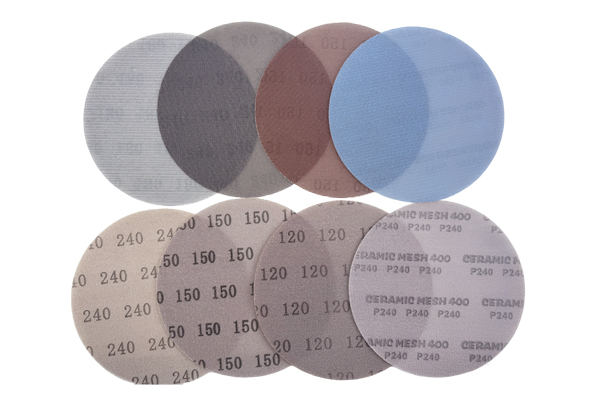
Mesh sanding discs, also widely named net sanding discs, dust-free sanding discs and mesh abrasive discs, are professional open-weave abrasive tools designed to solve the common drawbacks of traditional solid sanding discs, including easy clogging, short service life and excessive dust accumulation.
Favored by auto body technicians, woodworkers, composite fabricators and metal finishing workers, these hook-and-loop abrasive discs have become a mainstream choice for high-precision dry sanding operations in industrial and workshop scenarios.
Different from conventional punched-hole sanding discs with limited fixed openings, mesh sanding discs adopt a full-surface continuous net structure. Abrasive grains are firmly bonded on flexible, high-tensile polyamide mesh backing.
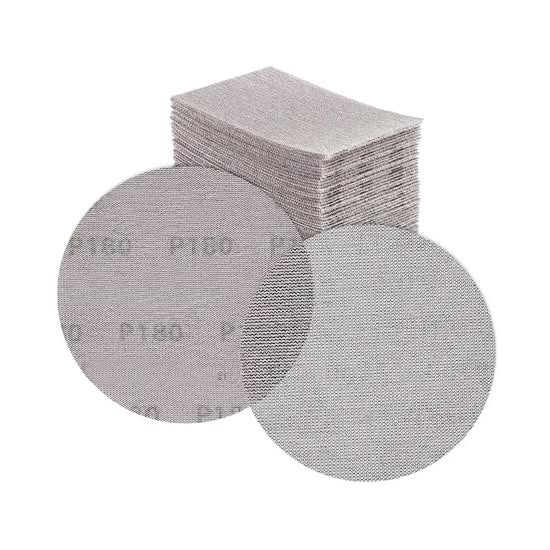
The entire working surface features breathable gaps, allowing wood dust, paint debris, primer residue and composite powder to pass directly through the mesh instead of accumulating on the disc surface.
This unique self-cleaning anti-clogging structure effectively avoids grit blockage, maintains stable cutting performance during long-term operation, and greatly extends disc service life compared with standard sandpaper discs.
Most mesh sanding discs adopt universal hook-and-loop (velcro) backing for quick installation and replacement. They are fully compatible with mainstream sanding equipment, including random orbital sanders, palm orbital sanders, air orbital sanders and rotary polishers.
Common specifications cover 2 inch, 3 inch, 5 inch and 6 inch diameters, matching the standard backing pads used in automotive refinishing, furniture manufacturing, boat repair and light metal processing.
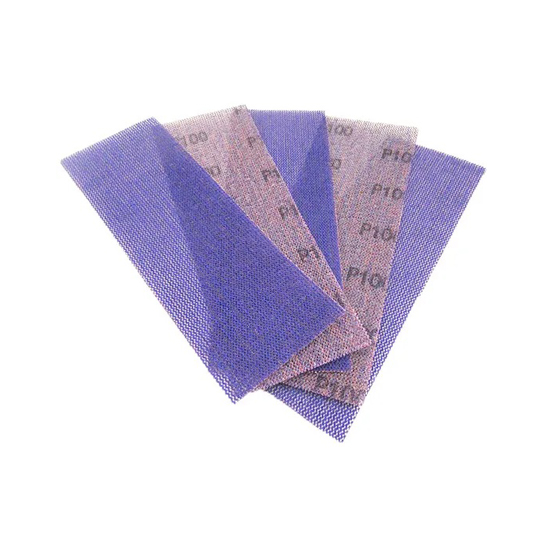
A complete grit range meets diverse polishing needs: coarse P40–P80 for heavy stock removal and surface leveling; medium P120–P240 for sanding body filler, putty and primer surfacer; fine P320–P2000 for ultra-smooth finishing before topcoat and clear coat application. Users can select corresponding grits according to different materials and finishing requirements.
The biggest advantage of mesh abrasive discs is excellent dust-free performance. When matched with a vacuum dust collection system, the full-mesh ventilation structure realizes thorough dust extraction, eliminating most airborne fine particles.
In auto body repair, traditional sanding discs easily trap paint and primer dust, causing heat accumulation, uneven scratch patterns and rapid abrasive dulling.
In contrast, mesh sanding discs discharge debris in real time, keeping the workpiece surface clean and the grit sharp. This not only improves finishing consistency and surface quality but also reduces operators’ inhalation of harmful dust, complying with workshop safety and environmental standards.
These net sanding discs deliver outstanding adaptability for multiple materials. In woodworking, they perform perfectly on solid wood, MDF, plywood and veneer.
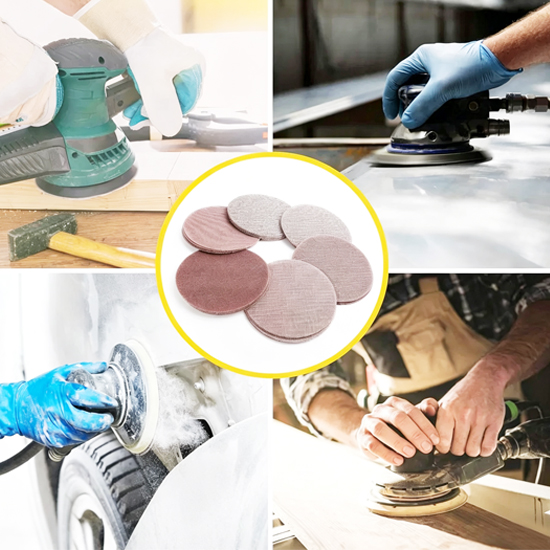
The open mesh structure effectively prevents resin and wood dust from gumming up the abrasive, a common problem with ordinary sandpaper on resin-rich timber. For composite processing, they are ideal for sanding fiberglass, carbon fiber and gelcoat, resisting loading from fine composite dust and maintaining stable cutting force.
They also support light and medium dry sanding on soft metals such as aluminum and brass. It is worth noting that excessive operating pressure is not recommended, which may cause workpiece burning and mesh backing damage. Besides, most standard mesh discs are designed for dry sanding, while individual waterproof models support mild wet sanding; they are not suitable for heavy grinding of hard thick steel.
Simple and standardized operation ensures stable finishing results. Before installation, clean the dust and worn hooks on the sander backing pad to ensure tight fitting. Align the mesh disc centrally and press firmly to avoid offset and orbital wobble that causes swirl marks.
Keep the sander moving continuously during operation to prevent local overheating and deep scratches. Replace discs timely once the mesh is torn, grits fall off or the velcro backing fails.


 +86 18503711019
 Call
Call